
Call us now :08045476033
 Send Inquiry
Spiral Phase Plate / Vortex Lens
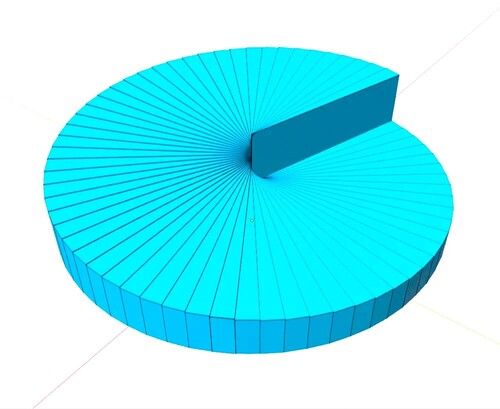

Spiral Phase Plate / Vortex Lens Specification
- Lens
- Vortex Lens / Spiral Phase Plate
- Accuracy
- High phase accuracy (typically λ/20) for precision beam shaping
- Magnification
- Not applicable (phase modifying optical element)
- Objective
- Creates an optical vortex with a specific topological charge
- Measurement
- Phase shift / Topological charge (l)
- Theory
- Imparts azimuthal phase shift according to spiral wavefront theory
- Color
- Transparent (optical clear)
- Product Type
- Diffractive Optical Element / Spiral Phase Plate
- Material
- Fused Silica
- Size
- 10mm - 25mm
- Weight
- Typically less than 20 grams depending on size
- Length
- Standard thickness 1 mm - 3 mm
- Function
- Generates optical vortices, helical phase fronts, and Laguerre-Gaussian modes
- Resolution
- Phase features down to sub-wavelength precision
- Mounting
- Unmounted, can be supplied in 25.4 mm (1\\
- Edge Finish
- Fine ground and beveled edge
- Operating Temperature
- 10C to 60C
- Damage Threshold
- >5 J/cm2 @ 1064 nm, 10 ns
- Surface Quality
- 10-5 scratch-dig or better
- Coating
- Uncoated or AR coated on request
- Wavelength Range
- UV, visible, or NIR compatible (customizable from 350 - 1600 nm)
- Topological Charge (l)
- Customizable (commonly l = 1 to l = 8)
- Phase Accuracy
- Clear Aperture
- Greater than 90% of diameter
- Flatness
- /10 over clear aperture
- Application
- Optical trapping, microscopy, quantum optics, laser mode conversion
Spiral Phase Plate / Vortex Lens Trade Information
- Minimum Order Quantity
- 1 Number
- Payment Terms
- Telegraphic Transfer (T/T), Letter of Credit (L/C)
- Delivery Time
- 6 Week
- Main Export Market(s)
- Asia, Australia
- Main Domestic Market
- All India
Spiral Phase Plate / Vortex Lens About
Spiral Phase Plate/ Vortex Lens is used to convert a Guassian laser beam to phase singular/ vortex beam. Spiral phase plate finds application in optical microscopy, optical communication, quantum computation and optical tweezers.
Product Specification
- Size : 10mm x 10mm - 25mm x 25mm
- Wavelength : UV, VIS, IR
- Material : Fused Silica
- Topological Charge : 1 - 32
- Transmission > 90%
Precision Optical Vortex Generation
This spiral phase plate leverages spiral wavefront theory to impart a controlled azimuthal phase shift on an incident beam, enabling the creation of optical vortices with specified topological charges. High phase accuracy (typically /20) ensures superior beam shaping, while phase features down to sub-wavelength precision make it a valuable addition to advanced photonics and laser laboratories.
Broad Compatibility and Customization
Designed for flexibility, the vortex lens supports a customizable wavelength range from 350 nm to 1600 nm (covering UV, visible, and NIR spectra) and allows tailoring of the topological charge (commonly l = 1 to l = 8) upon request. Options include AR coatings and multiple sizes (10 mm 25 mm), plus mounting in a standard 25.4 mm holder if desired.
Versatile Applications in Modern Research
Engineered for use in optical trapping, advanced microscopy, quantum optics, and laser mode conversion, this fused silica vortex lens is robust and reliable. Its high damage threshold, phase flatness, and fine surface attributes make it ideal for research environments requiring consistent precision and optical clarity across a wide temperature (10C to 60C) and operational range.
FAQs of Spiral Phase Plate / Vortex Lens:
Q: How does the spiral phase plate generate optical vortices?
A: The spiral phase plate modifies the phase of incoming light by imparting a controlled azimuthal phase shift according to spiral wavefront theory. This generates helical phase fronts, resulting in an optical vortex characterized by a specified topological charge (l).Q: What is the customization process for wavelength range and topological charge?
A: You can specify your required wavelength range (anywhere between 350 nm and 1600 nm) and select a custom topological charge (commonly l = 1 to l = 8) at the time of order. The manufacturer tailors the phase profile for optimal performance within the chosen parameters.Q: When should I request AR coating or mounting options?
A: AR (anti-reflection) coating and mounting in a 25.4 mm (1") holder can be requested during the order process if your application demands reduced surface reflections or convenient integration into optical setups. Standard supply is uncoated and unmounted unless otherwise specified.Q: Where is this vortex lens typically utilized?
A: This device is commonly used in advanced research settings such as quantum optics laboratories, high-resolution microscopy, laser beam shaping, and optical trapping experiments, where precise phase manipulation and vortex generation are critical.Q: What benefits does the high surface quality and flatness provide?
A: A surface quality of 10-5 scratch-dig and /10 flatness over the clear aperture ensures low scatter and high-quality phase transmission, resulting in improved optical performance and fidelity in demanding applications.Q: How is phase accuracy measured and what level can be achieved?
A: Phase accuracy for these spiral phase plates is typically /20, which means the imparted phase errors are minimized, ensuring precise control over beam shaping. Even higher accuracy (Q: What are the steps for integrating the spiral phase plate in my setup?
A: Simply install the plate in your beam path, ensuring the clear aperture aligns with the incident light. If mounting is required, opt for the standard 25.4 mm holder version. Ensure operational conditions (temperature, power) are within the specified range for best performance.Tell us about your requirement

Price: Â
Quantity
Select Unit
- 50
- 100
- 200
- 250
- 500
- 1000+
Additional detail
Mobile number
Email

More Products in Phase Singular Optics Category
Zero Order Vortex Half Wave Retarder
Price 130000 INR / Piece
Minimum Order Quantity : 1 Piece
Objective : Alter polarization state of transmitted light
Resolution : No imaging resolution; optical phase resolution at λ/50
Magnification : N/A (Not applicable for optical retarders)
Measurement : Halfwave (λ/2) phase shift

 Send Inquiry
Our Products

292, IInd Floor, Pocket B-1, Siraspur,Delhi - 110042, India

Mr Devinder Pal Ghai Sc G
(Director)
Mobile :08045476033
 Send Inquiry
 Send SMS
Developed and Managed by Infocom Network Private Limited.
