
Call us now :08045476033
 Send Inquiry
Michaelson Interferometer

Michaelson Interferometer Specification
- Color
- Blue/Grey
- Magnification
- 10x eyepiece, 20x objective
- Theory
- Interference of light based on superposition principle
- Objective
- To measure the wavelength and minute distances
- Measurement
- Precise measurement of optical path difference
- Lens
- Achromatic glass lens
- Accuracy
- Up to 0.01 micron
- Product Type
- Optical instrument
- Material
- Aluminum alloy and optical glass
- Size
- Standard laboratory size
- Weight
- Approx. 5 kg
- Length
- 300 mm
- Function
- Measures wavelength, thickness, refractive index, and surface irregularities
- Resolution
- Up to 0.05 micron
- Power Supply
- 230V AC (for illumination)
- Beam Splitter
- Precision optical glass
- Environmental Suitability
- Dust-proof housing
- Packaging
- Foam-lined safety case
- Light Source
- High intensity sodium lamp
- Table
- Rigid vibration-dampening base
- Mirrors
- Silver-coated, optically flat mirrors
- Adjustment
- Fine micrometer screw adjustments
- Application
- Used in laboratories for optics research and metrology
- Operating Temperature
- 0°C to 40°C
- Standards
- Complies with ISO optics standards
- Scales
- Graduated scale for micrometer reading
- Prism
- High transparency glass for beam deviation
Michaelson Interferometer Trade Information
- Minimum Order Quantity
- 1 Number
- Payment Terms
- Telegraphic Transfer (T/T), Letter of Credit (L/C)
- Delivery Time
- 6 Week
- Main Domestic Market
- All India
About Michaelson Interferometer
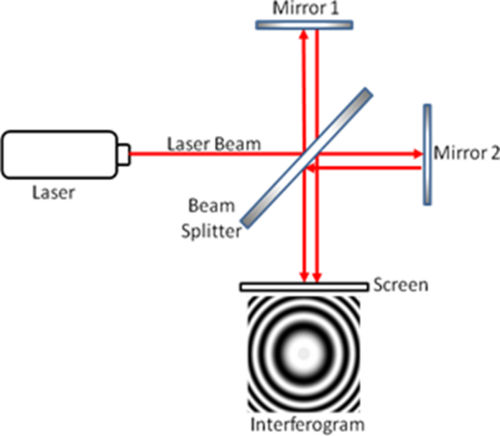
Michaelson Interferometer is a precision instrument that produces interference fringes by splitting a light beam into two parts and then recombining them after they have travelled different optical paths. It finds application in measurement of small displacements. It can also be used to determine the wavelength of an unknown optical source
Laser
- Type: Diode laser
- Wavelength : 650nm
- Output Power : 50 -100mW
Beamsplitter
- Type : Plate / Cube
- Size : 25mm
- Split Ratio : 50:50
Mirror
- Diameter : 50mm
- Thickness : 6mm
- Flatness : lambda/4 or better
- Mirror Movement : Manual or PZT actuator
Precision and Accuracy
This Michaelson Interferometer is engineered for the highest accuracy, reaching measurements as fine as 0.01 micron. The use of silver-coated optically flat mirrors, precision beam splitter, and a finely graduated scale ensures that all data recorded is reliable and repeatable, making it indispensable for research and quality assurance.
Robust Construction and Practical Design
Featuring an aluminum alloy body and mounted on a rigid vibration-dampening table, the instrument is optimized for long-term durability and resistance to environmental disturbances. Its dust-proof housing and foam-lined carrying case guarantee safe storage and transit, ideal for demanding laboratory environments.
Advanced Optics for Detailed Analysis
Equipped with a high-intensity sodium lamp, achromatic glass lens, prism, and magnifications up to 20x, the interferometer delivers sharp, clear fringe patterns. This enables precise examination of optical path differences, rapid wavelength determination, and analysis of surface irregularities with outstanding clarity.
FAQ's of Michaelson Interferometer:
Q: How does the Michaelson Interferometer with sodium lamp operate in laboratory research?
A: The Michaelson Interferometer utilizes the superposition principle of light to create interference patterns. By finely adjusting the mirrors and beam splitter using micrometer screws, the device can precisely measure the optical path difference, making it essential for experiments involving wavelength determination and metrology.Q: What can be measured using this interferometer?
A: This instrument measures the wavelength of light, refractive index of materials, thickness of thin films, and detects minute surface irregularities. It achieves resolutions up to 0.05 micron, making it suitable for detailed optical metrology and materials analysis.Q: When should I use this interferometer instead of other optical instruments?
A: The Michaelson Interferometer is ideal when exceptional measurement precision is required, such as in wavelength determination, thin film analysis, or when assessing optical component quality. Its high accuracy and sensitivity make it preferable over less sensitive equipment for advanced laboratory applications.Q: Where can the Michaelson Interferometer be installed and used?
A: Designed for laboratory settings, this device can be installed on standard lab benches. Its dust-proof housing and sturdy construction allow use in research institutions, universities, and quality control labs throughout India and internationally.Q: What is the process for achieving precise measurements with this device?
A: Begin by mounting the sample and illuminating the setup with the high-intensity sodium lamp. Gradually adjust the micrometer screw to manipulate mirror positions and produce clear interference fringes. The graduated scale assists in quantifying the fringe displacement, from which precise optical path differences and material properties are calculated.Q: How does the rigid base and dust-proof housing benefit the user?
A: The rigid vibration-dampening base minimizes measurement errors from environmental vibrations, ensuring consistent fringe patterns. The dust-proof housing protects sensitive optical components, reducing maintenance and extending instrument lifespan.Q: What advantages does this instrument offer to labs and researchers?
A: Labs benefit from fast, accurate, and reliable measurements that support cutting-edge optical research and quality control. The device's adherence to ISO optics standards and robust packaging further ensures long-term, trouble-free operation in any professional laboratory.Tell us about your requirement

Price:
Quantity
Select Unit
- 50
- 100
- 200
- 250
- 500
- 1000+
Additional detail
Mobile number
Email

More Products in Interferometers Category

Mach Zehnder Interferometer
Price 80000 INR / Number
Minimum Order Quantity : 1 Number
Product Type : Mach Zehnder Interferometer
Accuracy : High precision, up to nanometer level wavefront measurement
Function : Division of amplitude for phase measurement
Lens : Achromatic doublet lens

 Send Inquiry
Our Products

292, IInd Floor, Pocket B-1, Siraspur,Delhi - 110042, India

Mr Devinder Pal Ghai Sc G
(Director)
Mobile :08045476033
 Send Inquiry
 Send SMS
Developed and Managed by Infocom Network Private Limited.
